Workforce Engineering has always existed. We just never named it.
Every discipline starts the same way. People do the work for years before anyone thinks to define it. Software engineering existed before the term did. DevOps was a practice before it was a category. FinOps was a spreadsheet and a prayer before someone decided cloud cost management deserved a name and a conference.
Workforce Engineering is the same. Every leader who has ever tried to figure out whether their team is deployed correctly, whether the right people are on the right things at the right cost, has been doing Workforce Engineering. They just didn’t call it that. They called it quarterly planning, or headcount review, or the spreadsheet they rebuilt every three months and hated every time.
I’ve been doing it for most of my career. I suspect you have too.
What’s actually been happening
Think back to every resourcing conversation you’ve had. Someone asks: is this project appropriately staffed? Are we getting value from this team? If we shifted two people from team A to team B, what would change? You shift two senior engineers to the new AI initiative, but because you couldn’t see the downstream dependencies, your core product’s release slips by a month. Everyone saw the move. Nobody saw the consequence until it landed.
These aren’t HR questions. They’re systems questions. You’re trying to model a system (inputs, outputs, constraints, trade-offs) and make decisions that optimise for outcomes. The fact that the inputs are people rather than servers doesn’t change the fundamental nature of the work.
But we’ve never treated it like an engineering discipline. We’ve treated it like a gut feel, dressed up in a spreadsheet. You take headcount numbers, multiply by salary bands, divide by the number of active projects, and arrive at a number that feels approximately right until someone leaves or a new priority lands from the board.
The problem was always measurement. You can’t engineer what you can’t instrument. And for most organisations, the workforce has been almost entirely uninstrumented. You know what you’re paying. You have a rough idea of what people are working on. The connection between those two things, what effort was deployed against which outcomes at what cost, has been a black box.
That’s the gap Workforce Engineering fills.
The definition
Workforce Engineering is the discipline of deliberately designing, measuring and optimising how an organisation deploys its labour to produce outcomes.
It treats the workforce as a system. Like any system, it can be instrumented, modelled, forecasted and improved. The goal isn’t visibility for its own sake. It’s the ability to make better decisions, faster, with less guesswork. And to be clear: this isn’t about squeezing more out of people. It’s about protecting them from thrash, burnout and misaligned priorities by ensuring the system around them is balanced.
It has six core practices:
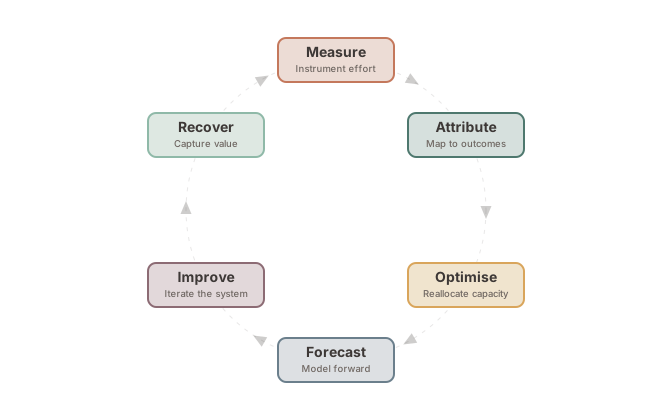
Measure. Instrument the workforce properly. Who is working on what, at what cost, toward which outcomes? This is the foundation. Without it, everything else is estimation.
Attribute. Connect effort to outcomes at the project level. Not “we spent £400k on this team last quarter” but “that £400k broke down across these five projects, with this output, and this AI leverage factor.”
Optimise. Make active decisions from the data. Reallocate capacity where it’s needed. Cut spend where it isn’t generating returns. Identify where AI is genuinely accelerating delivery and where it’s burning budget without moving the needle.
Forecast. Project forward with confidence. Model the impact of hiring decisions, team changes and AI investment before you make them, not explain the consequences after.
Improve. Treat it as an iterative discipline, not a quarterly event. The plan you build in January is wrong by February. A live system that reflects reality is worth more than a perfect plan that goes stale.
Recover. Good Workforce Engineering pays for itself. When you can see clearly what your workforce is doing and where the effort lands, you unlock financial value that was always there but invisible: R&D tax relief, CapEx classification, elimination of redundant tooling. Most organisations leave significant money on the table not because they’re negligent, but because they’ve never had the visibility to claim it.
Why now
Workforce Engineering has always existed in practice. But right now, it’s becoming urgent. Two forces have collided simultaneously, and the window to get ahead of both of them is narrow.
The first is AI spend. The role of the engineer has fundamentally shifted from individual contributor to orchestrator of AI agents, but our operating models still treat them like standard headcount. Meanwhile, enterprise AI spend is growing faster than anyone planned for and landing in the budget without a clear owner. Enterprise AI spend is projected to grow 36% year on year. Most of that is going into tooling, assistants, LLM APIs and agentic infrastructure across every function, and most finance teams have no idea what it’s producing. It sits somewhere between a software subscription and an infrastructure cost, classified inconsistently, reviewed quarterly at best.
The CTOs and CFOs we talk to aren’t asking abstract questions about AI strategy. They’re asking: what are we actually getting for this? Is our AI investment accelerating delivery or just adding cost? If we doubled the budget, what would change? They don’t have answers because the tooling to answer those questions hasn’t existed until now.
This is a defining moment. The companies that build the infrastructure to measure and manage AI as a form of labour right now will have a structural advantage over those that figure it out two years later, after the spend has scaled and the waste has compounded. We’re talking to organisations spending hundreds of thousands a year on AI tooling with no way to connect it to a project or an outcome. That’s not a small problem. It’s a governance crisis in slow motion.
The second force is structural pressure on labour costs more broadly. Private equity dealmaking hit $602 billion in 2024, with technology capturing a third of all deals. Operational excellence now drives 47% of PE value creation, up from 18% a decade ago. The question isn’t whether your organisation will face this scrutiny. It’s whether you’ll be ready when it arrives.
The two forces compound each other. AI spend is growing inside budgets that are already under pressure to justify themselves. The old proxies (headcount, utilisation rates, output per head) were already inadequate. They’re now actively misleading. You need a different system.
Why we named it
When Oliver and I were building Flowstate, we kept coming back to the same tension. The product we were building had clear value: connecting human effort data to project outcomes, integrating AI spend, enabling real workforce decisions. But the category didn’t exist to describe it.
Workforce Management is the wrong frame. That’s scheduling, time and attendance, shift workers. It’s Workday and ADP and tools built for a world where the unit of labour is a person clocking in.
FinOps is the wrong frame. That’s cloud costs. Genuinely useful category, wrong problem.
Engineering Management is the wrong frame. Too operational, too eng-leader-specific, doesn’t capture the financial dimension.
None of them describe what we’re actually doing: treating the workforce, human and AI, as a system to be engineered.
So we named it. Workforce Engineering. Not because we invented the practice (as I said at the start, people have been doing this for years) but because naming it matters. A discipline without a name is hard to invest in, hard to hire for, hard to build tooling around. Names create categories, and categories create markets.
We’re defining this one deliberately, because we think the companies that adopt Workforce Engineering as a practice, not just buy a tool, will make fundamentally better decisions about how they deploy their most expensive and most valuable resource.
What winning looks like
You know you’re doing Workforce Engineering well when:
- You can answer “are we getting more efficient?” with data rather than a feeling
- Every pound of labour, human or AI, is traceable to a project and an outcome
- Headcount decisions get made with the same rigour as capital investment decisions
- You can forecast delivery cost before a project starts, not explain overruns after it ends
- Reallocation decisions happen proactively rather than in the post-mortem
- Leadership trusts the plan enough to move faster instead of asking for another review cycle
- You stop losing good people to misallocation because you can see the problem before they start interviewing elsewhere
Most organisations are nowhere close. But the ones that are didn’t get there by buying a tool or adopting a framework. They got there because someone decided to treat the problem seriously — to name it, instrument it and iterate on it the same way they would any other engineering challenge.
That’s all Workforce Engineering is. A name for the discipline you’ve probably been practising without one.
I’m the Co-founder and CTO at Flowstate, the Workforce Engineering platform for modern organisations. We help companies connect human effort and AI spend to project outcomes, so they can make better decisions about how they deploy their workforce.